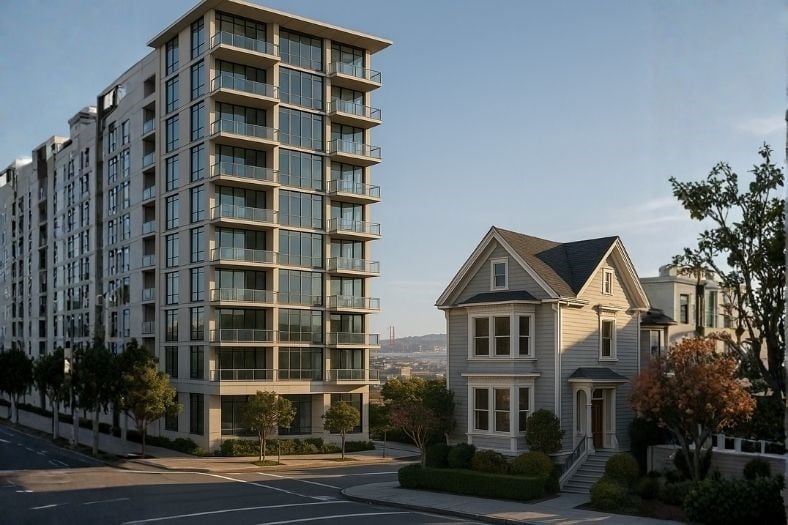
In South Orange County, the median attached home (condo or townhome) sold for $810,000 in late 2025 while the median detached single-family home sold for $1,400,000, a $590,000 spread. That price gap is the most visible difference, but it is not the most important one. Selling a condo and selling a single-family home are two different transactions with different buyer pools, different financing requirements, different disclosures, different insurance rules, and different timelines. Sellers who treat them the same lose money. This guide walks through every meaningful difference for South OC sellers in 2026.
The Price Spread, 2026
| Property Type | OC Median Sale Price (Late 2025) | YoY Change | South OC Typical Range |
|---|---|---|---|
| Attached (condo/townhome) | $810,000 | -2.9% | $550K-$1.1M depending on city |
| Detached (single-family) | $1,400,000 | -5.7% | $1.0M-$2.5M+ depending on city |
| Spread | $590,000 | — | Roughly 65-80% difference |
Source: Norada Real Estate, December 2025 OC data.
In Mission Viejo specifically, condos and townhomes typically trade in the $700K-$800K range. Single-family homes run $1.1M-$1.7M depending on neighborhood. In Aliso Viejo and Lake Forest, condos can start in the high $500Ks and run to the $850K-$900K band. Laguna Niguel coastal-adjacent condos can hit $1.2M.
The price spread matters because it determines the buyer pool you are marketing to, the financing those buyers will use, and the speed at which they can close.
The Buyer Pool Is Completely Different
A condo buyer is most often a first-time buyer, a single professional, a downsizing empty-nester, or an investor. A single-family buyer is most often a move-up family, a relocating family, or a multi-generational household.
Condo buyers:
- 35-50% are first-time buyers
- Frequently use FHA loans, conventional 3-5% down, or VA loans
- Sensitive to monthly carrying cost (HOA + mortgage + tax)
- More price-elastic, more likely to walk on inspection items
- Often comparing your unit against 3-5 others in the same building or complex
Single-family buyers:
- 70%+ are move-up or repeat buyers
- More likely conventional 20%+ down or cash
- More tolerant of higher purchase price if condition is right
- Less sensitive to monthly HOA (because SFR HOAs are usually $125-$350 if any)
- Comparing your home against other single-family homes in the same school zone
These are not interchangeable audiences. The marketing, the staging, and the pricing strategy that works for one fails for the other.
Financing: The Single Biggest Hidden Variable
This is where condo sales go sideways most often.
For a buyer to get a conventional Fannie Mae or Freddie Mac loan on a condo, the project itself must be "warrantable." That means the HOA financials, owner-occupancy ratio, insurance coverage, litigation status, and budget reserves all have to meet specific guidelines. If the project fails warrantability, your buyer either has to put 20%+ down on a portfolio loan (which is more expensive) or back out entirely.
For FHA loans, the entire condo project has to be on the FHA-approved list. If it is not, your FHA buyer cannot close. Period.
For VA loans, the project has to be on the VA-approved condo list.
For single-family homes, none of this applies. The lender underwrites the property and the borrower. There is no "project approval" step.
What this means in practice for South OC condo sellers:
- Pull your HOA's warrantability status before listing. If your project is not warrantable, you have a smaller buyer pool, and you need to price accordingly.
- Check the FHA and VA approval lists. If your project is not on them, FHA and VA buyers are out.
- Have your HOA's documents ready before listing. Lender review takes 7-14 days. Delays at this stage extend the close timeline.
In South OC, the most common warrantability issues are: less than 50% owner-occupancy, pending litigation against the HOA, deferred maintenance flagged in reserve studies, and inadequate insurance coverage.
Disclosures: Condos Require Significantly More
Single-family home sellers in California provide the standard disclosure package: Transfer Disclosure Statement, Seller Property Questionnaire, Natural Hazard Disclosure, and other items as relevant (lead-based paint if pre-1978, etc.).
Condo sellers provide all of that PLUS the full HOA document package required by California Civil Code:
- CC&Rs (covenants, conditions, and restrictions)
- Bylaws
- Articles of incorporation
- Current operating budget
- Reserve study and reserve fund balance
- Most recent financial statements
- Insurance certificates
- Most recent 12 months of board meeting minutes
- Statement of any pending litigation
- Statement of any past, current, or contemplated special assessments
- Statement of fees, fines, and assessments owed by the seller
In California, the HOA must produce these documents within 10 days of the seller's request. The cost typically runs $200 to $500 depending on the management company.
If special assessments exist or are being contemplated, disclose them in writing. Buyers will find out. Hiding them is the fastest way to lose a deal in escrow and create legal liability.
Insurance: Different Policies, Different Costs
Single-family home sellers carry an HO-3 policy that covers the structure, contents, and liability. South OC HO-3 premiums in 2026 typically run $1,400-$1,800 per year, though the California insurance market pullback has pushed premiums higher and made coverage harder to secure in certain areas.
Condo sellers carry an HO-6 policy that covers the interior of the unit, personal contents, and liability inside the unit. The exterior, roof, and common areas are covered by the master HOA policy. HO-6 premiums typically run $400-$800 per year.
What buyers care about: the master HOA policy. If the master policy has high deductibles, coverage gaps, or has been canceled by a major California carrier, lenders will flag it. Buyers may have to gap-fill with additional coverage, which affects their qualifying.
Verify your HOA master policy is current and adequate before listing. If it is not, the issue often takes weeks to resolve.
Staging and Showing: Different Playbooks
A single-family home shows on its own. The buyer arrives, walks the property, evaluates the yard, the curb appeal, the neighborhood feel, and the interior. The home stands alone.
A condo shows in context. The buyer evaluates the building or complex first (lobby, halls, parking, amenities), then the unit. The unit's selling proposition is partially the unit itself and partially the building's lifestyle.
Staging implications:
- Single-family staging emphasizes lifestyle and space. Bigger furniture, more rooms staged, outdoor spaces dressed.
- Condo staging emphasizes efficient use of space. Smaller-scale furniture, vignettes that show the unit working for one or two people, balcony or patio styled.
Showing implications:
- Single-family showings are private and scheduled. Lockbox, agent shows, owner often not present.
- Condo showings often involve concierge, gate guards, or building access protocols. Plan accordingly. Make sure your agent has communicated the entry process to other agents before they arrive.
Timeline: Condos Take Longer to Close
In South OC in 2026, single-family homes priced correctly close in roughly 21-30 days. Condos priced correctly close in roughly 30-40 days.
The reason is documentation. Lender review of the HOA project package adds 7-14 days. If the HOA management company is slow to produce documents, add more. If the project has any warrantability question, add more.
Plan for this. Set buyer expectations on close timelines that reflect condo reality, not single-family reality. Sellers who try to force a 21-day close on a condo end up extending and frustrating the deal.
Selling Costs and Commissions
Standard South OC seller costs run roughly 6-8% of sale price, including agent commission, title and escrow fees, transfer tax, HOA transfer fees, and capital improvement fees.
For condos, add the HOA document fees ($200-$500), HOA transfer fees ($100-$400), and any move-out fees imposed by the HOA. Some HOAs charge capital improvement contribution fees on resale that can add 0.1-0.5% of sale price.
For single-family homes, costs are mostly fixed: title, escrow, transfer tax, and commission.
On a $1.4M single-family sale, total seller-side closing costs typically run $90,000-$110,000. On an $810,000 condo sale, total closing costs typically run $58,000-$70,000.
Strategic Implications by Seller Type
Move-Up Seller (Avatar 1): If you currently own a condo and are moving up to a single-family home, sequence matters. Sell the condo first or buy contingent. Condo close timelines are longer, so building in a 45-60 day close window is safer than 30.
55+ Downsizer (Avatar 2): If you currently own a single-family home and are moving into a condo or 55+ community, the math runs the opposite direction. You will sell the SFR fast and the condo purchase will take longer. Prop 19 lets you transfer your Prop 13 base, so the tax math is in your favor.
Investor: Condos have a higher cap rate but a smaller appreciation curve in most South OC submarkets. Single-family homes have lower yield but stronger long-term appreciation. The split shows up in resale comps over 5-10 year holds.
Estate Seller: Estate single-family homes often need more pre-sale prep (landscaping, exterior touch-ups, dated kitchens). Estate condos are often easier because the building handles the exterior. Probate timelines and disclosure obligations differ depending on whether the property is going through full probate or has been transferred via trust.
FAQ
What is the median price of a condo vs a single-family home in Orange County in 2026? The OC median attached home (condo or townhome) sold for $810,000 in late 2025, down 2.9% year over year. The OC median detached single-family home sold for $1,400,000, down 5.7% year over year. The spread is roughly $590,000.
Why is selling a condo more complicated than selling a single-family home? Three reasons: condos require HOA project warrantability review by the buyer's lender, condos require a significantly larger disclosure package (HOA financials, reserves, meeting minutes, insurance, litigation status), and condo close timelines are typically 7-14 days longer because of the document review process.
What is a warrantable condo and why does it matter? A warrantable condo project meets Fannie Mae and Freddie Mac guidelines for owner-occupancy, financial reserves, insurance coverage, litigation status, and budget. If a project is not warrantable, buyers cannot get conventional financing and must use higher-cost portfolio loans or 20%+ down. This shrinks your buyer pool significantly.
Are FHA and VA loans available for all condos in South OC? No. The condo project must be on the FHA-approved list for FHA loans, and on the VA-approved list for VA loans. Many South OC condo projects are not approved. Check before listing if your buyer pool includes FHA or VA buyers.
How long does it take to sell a condo vs a single-family home in South OC? Single-family homes priced correctly close in 21-30 days. Condos priced correctly close in 30-40 days. The extra time is mostly lender review of HOA documents.
Do condos appreciate as fast as single-family homes? Generally no in South OC. Single-family homes have lower yield but stronger long-term appreciation curves over 5-10 year holds. Condos are typically more price-elastic and more sensitive to interest rate moves.