Yes, for the right type of family, Mission Viejo is an excellent place to land after San Diego. But the reasons people make this move are specific, and so is the trade-off. This isn't a cost-of-living downgrade. Mission Viejo's citywide median sale price sits at approximately $1.1M to $1.17M in early 2026, while San Diego County's median was approximately $918K in early 2026. You're spending more. What you're buying is a master-planned community structure, a top-tier school district, and one of the lowest crime rates of any large city in California. Whether that trade makes sense depends entirely on where you are in life.
The First Thing to Know: Mission Viejo Costs More Than San Diego
Most people assume they're trading down in price when they move from San Diego to South Orange County. That assumption is wrong.
Mission Viejo's median runs $1.1M to $1.17M in early 2026, with Pacific Hills commanding a median of $1,735,000 and Casta del Sol running around $955,000 on the lower end. Compare that to San Diego, where the county median sits at approximately $918K, with the median price per square foot at $592.
The price premium in Mission Viejo is not random. It reflects three things: Capistrano Unified School District boundaries, Lake Mission Viejo access, and the master-planned infrastructure of the city itself. In sub-neighborhoods like Pacific Hills and Deerfield, the school zone is the single largest driver of value. That is not hyperbole. It shows up in the comps.
Families who make this move successfully do it with clear eyes about what they're paying and why.
Schools Are the Reason Most Families Choose Mission Viejo Over San Diego
San Diego has strong school pockets. Poway Unified, Del Mar Union, and Carmel Valley are well-regarded. But families in San Diego's inland and central neighborhoods are frequently zoned into San Diego Unified, which is a large, varied district with inconsistent school-level performance.
Mission Viejo is primarily served by Capistrano Unified School District, consistently ranked among the top districts in South Orange County. The difference between Mission Viejo's CUSD-zoned neighborhoods and its non-CUSD pockets shows up directly in sale prices. Saddleback Valley Unified serves a smaller slice of the city, primarily in its western edge.
If you are coming from a top-performing San Diego corridor, you will find comparable school quality in Mission Viejo's CUSD neighborhoods, with the added advantage of a smaller, more cohesive district structure and a city where school boundaries are easier to navigate. If you are coming from a lower-performing San Diego school zone, Mission Viejo will feel like a significant upgrade.
Before you buy in Mission Viejo, verify the school zone for the exact address. The difference between CUSD and SVUSD is not reflected uniformly in list price, but it is reflected in long-term resale demand.
Safety: What Makes Mission Viejo Different
San Diego is not a high-crime city relative to national averages, but it is a large, diverse metro with meaningful variation by neighborhood. Areas like Barrio Logan, City Heights, and parts of National City carry substantially higher crime rates than the coastal enclaves.
Mission Viejo operates differently. It is regularly cited as one of California's safest large cities, with both property crime and violent crime rates well below the state average. The master-planned structure of the city, HOA oversight, and the demographic profile of its population all contribute to that outcome.
For families moving out of San Diego with school-age children, this is not a minor data point. It consistently ranks in the top reasons people give for making this specific move.
What Mission Viejo Looks and Feels Like Compared to San Diego
San Diego is a city. It has urban neighborhoods, beach communities, a substantial downtown, military presence, a biotech corridor, and enormous geographic variety across 325 square miles. Mission Viejo is none of those things.
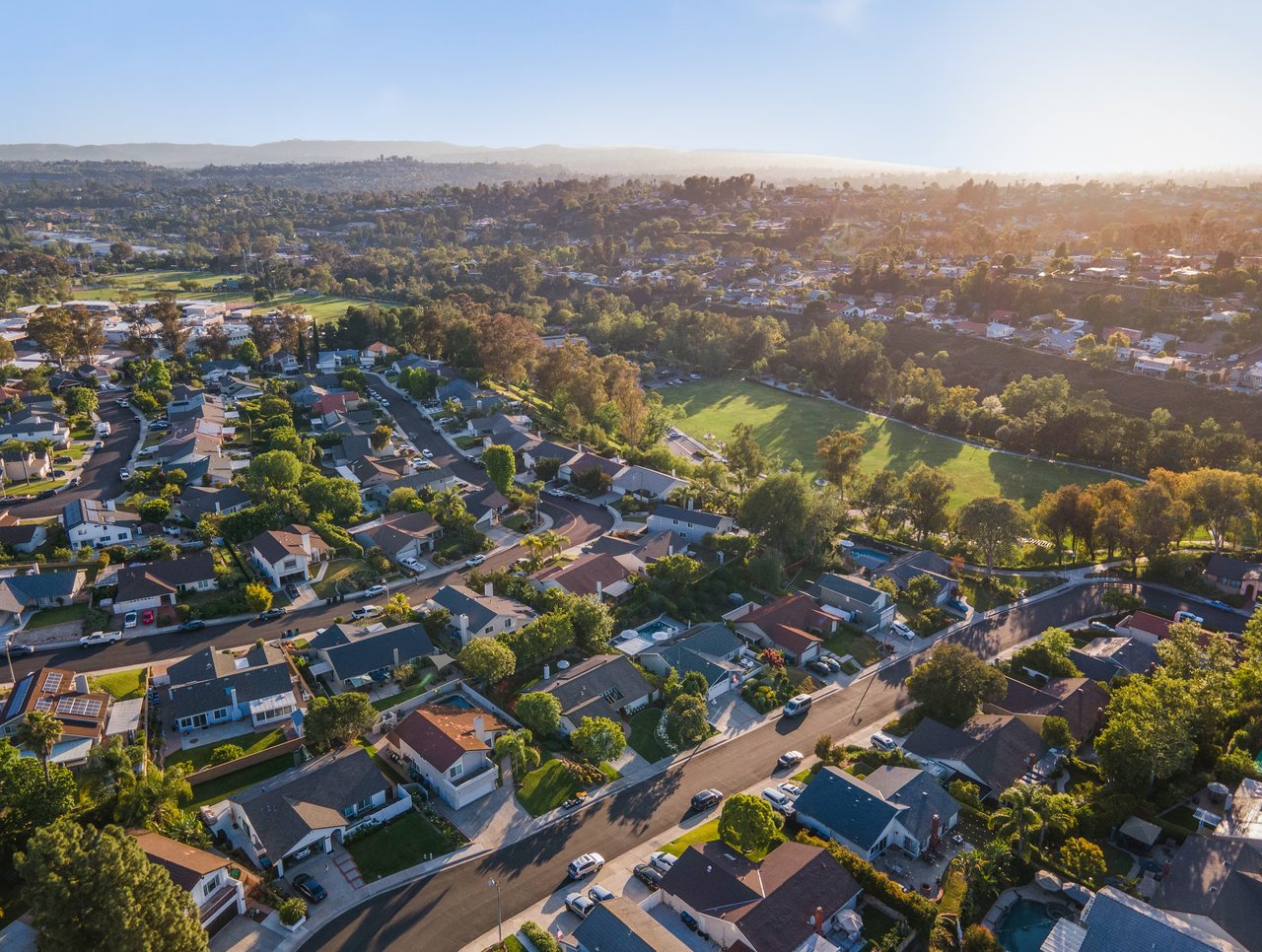
Mission Viejo is the only master-planned city in Orange County, designed in the 1960s by the Mission Viejo Company as a cohesive, self-contained community. The result is a city that feels organized in a way San Diego does not: HOA neighborhoods with maintained common areas, a 124-acre private lake with beach clubs and summer programming, over 70 parks, and one of the more intact examples of mid-century California suburban planning anywhere in the state.
Lake Mission Viejo provides residents with lake access, and homes within eligible communities carry a measurable premium over otherwise-comparable properties without access. The lake is a genuine differentiator, not a marketing bullet. Families who move here for it tend to stay specifically because of it.
HOA fees in Mission Viejo range from roughly $200 to $700 per month depending on the community and amenities. Buyers coming from San Diego's non-HOA neighborhoods sometimes underestimate this line item. Budget for it explicitly.
The Price Reality by Neighborhood
The citywide median of $1.1M to $1.17M doesn't tell you much. Mission Viejo's sub-neighborhoods trade at very different levels.
Pacific Hills runs at a median around $1,735,000, while Palmia sits near $1,168,750, and Casta del Sol, the city's 55+ community, runs approximately $955,000. Finisterra condos and townhomes provide a lower entry point, typically in the $700K-$800K range.
For buyers coming from San Diego's $900K-$1.1M single-family range in neighborhoods like Clairemont, Mission Hills, or North Park, the step up to Mission Viejo is real. For buyers coming from Del Mar, Carmel Valley, or La Jolla, Mission Viejo will feel more affordable for the square footage and lot size, even if the brand doesn't carry the same coastal cachet.
The number most buyers from San Diego underestimate is what the Zestimate shows versus what a CMA from local MLS data shows. The automated valuation tools miss HOA differentials, lake access, and school-zone micro-premiums. In Pacific Hills specifically, the gap between what Zillow estimates and what the market actually pays runs 8 to 12 percent. A local CMA before you make an offer is not optional.
What You Give Up Moving from San Diego
This matters, and it's worth being direct about.
San Diego's coastal access is different from South OC's. Dana Point and Salt Creek are good beaches, but they are not La Jolla or Coronado. The drive is 20 to 25 minutes from most MV neighborhoods, which is fine for weekend use and difficult for people who walk to the beach on Tuesday evenings.
San Diego's restaurant and nightlife culture is more developed. North Park, Hillcrest, Little Italy, and the Gaslamp Quarter give the city a food and entertainment scene that Mission Viejo doesn't attempt to replicate. The Shops at Mission Viejo and a strong local restaurant strip exist, but this is a suburban community, not an urban one.
If you work in San Diego and are considering this move, the commute deserves serious attention. I-5 south through Camp Pendleton can run 60 to 90 minutes each direction during peak hours. Hybrid schedules have made this workable for many families. A daily in-office requirement makes it a much harder sell.
Who Makes This Move and Why It Tends to Work
The families who move from San Diego to Mission Viejo and stay without regret typically share a few characteristics.
They have school-age children and have exhausted their school options in San Diego without landing in a top-tier zone. They want a HOA community with structured amenities. They work in Orange County or have moved to a fully remote role. They are not daily beach-goers. And they have done the school-zone research before buying, not after.
The families who make the move and second-guess it usually made one of two mistakes. They bought without verifying the school zone for the specific address. Or they underestimated how much they relied on San Diego's walkable urban neighborhoods and found Mission Viejo's car-dependent, HOA-governed structure more constraining than they expected.
Mission Viejo is an exceptionally livable city. It is not for everyone. Knowing which one you are before you sign is worth more than anything on this page.
Frequently Asked Questions
Is Mission Viejo more expensive than San Diego?
Yes. Mission Viejo's citywide median sat at approximately $1.1M to $1.17M in early 2026. San Diego County's median was approximately $918K over the same period. You pay more in Mission Viejo, but you're buying into a master-planned HOA community, Capistrano Unified School District, and significantly lower crime rates.
How are Mission Viejo schools compared to San Diego?
Mission Viejo sits primarily within Capistrano Unified School District, consistently rated among the top districts in South Orange County. Families moving from San Diego's top school corridors will find comparable or better performance in CUSD schools, with the added benefit that school zone boundaries directly drive home values in specific Mission Viejo sub-neighborhoods.
Is Mission Viejo safer than San Diego?
Mission Viejo is regularly ranked as one of California's safest large cities. Property crime and violent crime rates are both substantially lower than San Diego County averages. For families with school-age children, this is one of the most frequently cited reasons for making the move.
How far is Mission Viejo from San Diego beaches?
Mission Viejo sits approximately 55 to 65 miles north of downtown San Diego via I-5. Dana Point and Salt Creek Beach are roughly 20 to 25 minutes from most MV neighborhoods. You lose San Diego's immediate beach proximity, but South OC beaches are still accessible for weekend use.
What is the commute from Mission Viejo to San Diego?
Expect 60 to 90 minutes one way depending on traffic. I-5 south through Camp Pendleton is the primary route. The commute is manageable for hybrid workers but difficult for daily office commuters. Most people making this move either work in Orange County, work remotely, or have accepted a longer drive for the lifestyle trade-off.
Does Mission Viejo have HOA communities similar to San Diego's planned neighborhoods?
Mission Viejo is Orange County's only master-planned city, designed from the ground up with HOA communities, parks, and Lake Mission Viejo as the civic centerpiece. Most neighborhoods carry HOA fees ranging from roughly $200 to $700 per month. Lake Mission Viejo membership provides lake access, beach clubs, and summer concerts for residents of eligible properties.